The box with keyes, buttons and pleats, by Walter ?, 2009, translated by: Jola Simon, Buffalo, NY
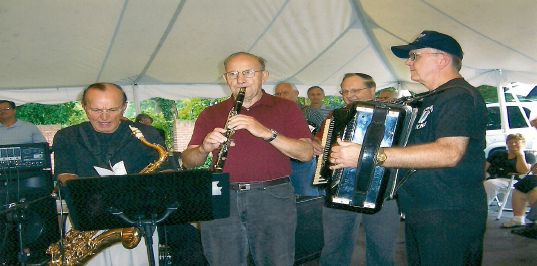
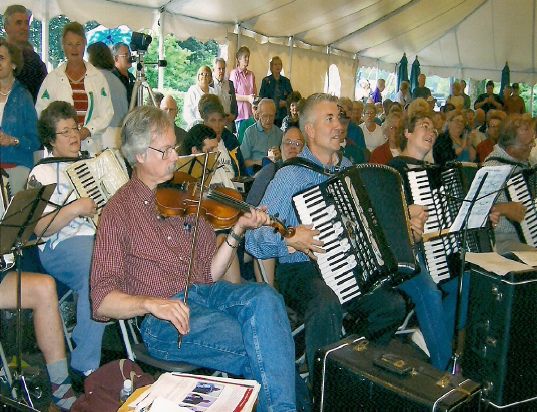
The Accordion Jam is one of the most popular Polish events in Rochester, New York. This year
brought a number of performers together on Sunday, July 19th, 2009 for the Fourth Annual
Accordion festival on the grounds of St. John Fisher college. The traditional sound of polka
played on the accordion is one of the milestones in the history of the Polish-american
community.
The "box with keys, buttons and pleats", that made its way here from Europe is considered one
of the basic musical instruments in America by many ethnic groups. Musical groups
performing the polka and other traditional folk songs are immediately recognized by the very
distinct sound of the accordion. The origins of the accordion date back to 1822. It is believed
that most accordions came to America with traveling German merchants and gained popularity
in various communities, including the Germanic regions of the northeast, and the cities of
Buffalo and Rochester, New York. There are a number of Polish-Americans who grew up with
the sounds of polka and proudly display those traditions. Among the most notable are Brass
Magic, Eddie Blazonczyk, Chicago Push, Gomolka and J. Sturr.
What exactly is the polka? Polka music is a form of European dance music which originated in
Bohemia (what is now an area within the Czech Republic) in the early 1800s and soon became
one of the most popular dances in European ballrooms, nearly overshadowing the traditional
waltz. The Chech name půlka (half-step) was eventually modified to polka, in part to honor
Poles who took part in the November uprising. A popular type of the polka with the rythm of
the Mazurek, or the Polka-Mazurka is well known in many Eastern European countries,
including Poland, Lithuania, Bielorus, and the Ukraine. Some of the best known composers of
the polka include Johann Strauss, Stanislaw Moniuszko and Dvorak. Contemporary musicians
who write and play the "street polka" at dances and festivals combine polish culture and
traditions with those of other nations and generations. During the 1940s and '50s musicians
such as Bernard Witkowski and his Silver Bells Orchestra, Walter Solak or Maly Wladziu from
Chicago made the polka popular around the American continent. More recently, Bobby Vinton
also known as "the Polish Prince" topped the charts with his song "Moja droga ja cię kocham"
or "My Melody of Love", whose sounds resonated even in Poland.
The Annual Accordion Jam in Rochester, held for the first time back in 2005, is sponsored by
the Polish Heritage Society of Rochester and organized under the careful direction of Jerry
Rachwal from Pittsford, NY. Although born in America, Jerry says "I am Polish and the
polka is my music."
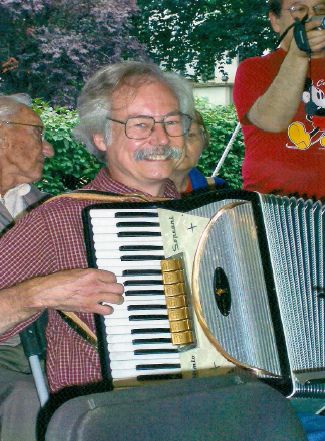
2009's event at St. Johhn Fisher college brough out some three hundred enthusiasts as well
as musicians who brought their instruments and joined John Firth, Ted Kania and Danny
Mocniak along with 15 accordionists in an impromptu polka jam session. In the USA the polka
is considered a traditional dance of Polonia and we should be happy that there is something that
helps bind our culture and traditions on this continent. In fact, John Firt, a retired jeweler
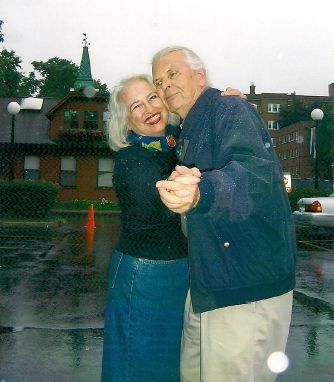 recalls how in the early 1900's immigrants not only made the polka popular but insisted that
younger generations learn to play "the box with keyes, buttons and pleats". The phrase "If
you're Polish you have to play the accordion and dance when you hear the sounds of polka"
echoed throughout polish communities in America.
recalls how in the early 1900's immigrants not only made the polka popular but insisted that
younger generations learn to play "the box with keyes, buttons and pleats". The phrase "If
you're Polish you have to play the accordion and dance when you hear the sounds of polka"
echoed throughout polish communities in America.